Atlan cockpit.
Chat, editor, terminal, live preview, agent fleet, and build pipeline — one surface that orchestrates every major coding agent on your own subscriptions, plus a free local model running on your own hardware. Built phone-first, bound to loopback, Apache-2.0.
I got tired of building across a dozen fragmented tools. Atlan is the answer: a single cockpit where the model, the code, the terminal, the preview, and the agent runs all live in one place — and where I can do all of it from a phone if that's what I have on me.
Every engine, one surface, your own subscriptions
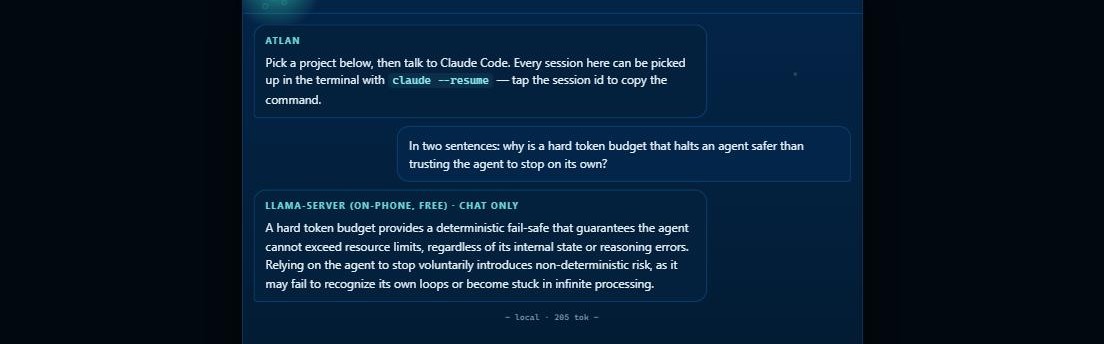
The model picker holds Claude, Codex, Gemini, Grok, and Copilot as first-class coding agents, a dozen bring-your-own-key chat providers, and — at the bottom of the list — llama-server, running free on my own GPU. Six local models sit on disk, hot-swappable from inside the cockpit: pick one, and it repoints the symlink and restarts the service. Everything authenticates on your own subscription, within each vendor's terms. No API keys required to start, and no paywall between a person and their first build.
Probabilistic workers, deterministic walls
This is the thesis that runs through everything I build. Agents are excellent at proposing and unreliable at stopping. So the walls are code, not vibes:
- Budgets that halt, not warn — a run stops dead at its token ceiling and waits for you to top it up
- Deterministic checkers grade agent output — code grades it, never another model
- An escalation ladder: free local model first, cheap cloud next, frontier only when the checkers demand it
- Double-belted permissions — profile-level tool denial plus a runtime gate, because either one alone has been proven insufficient
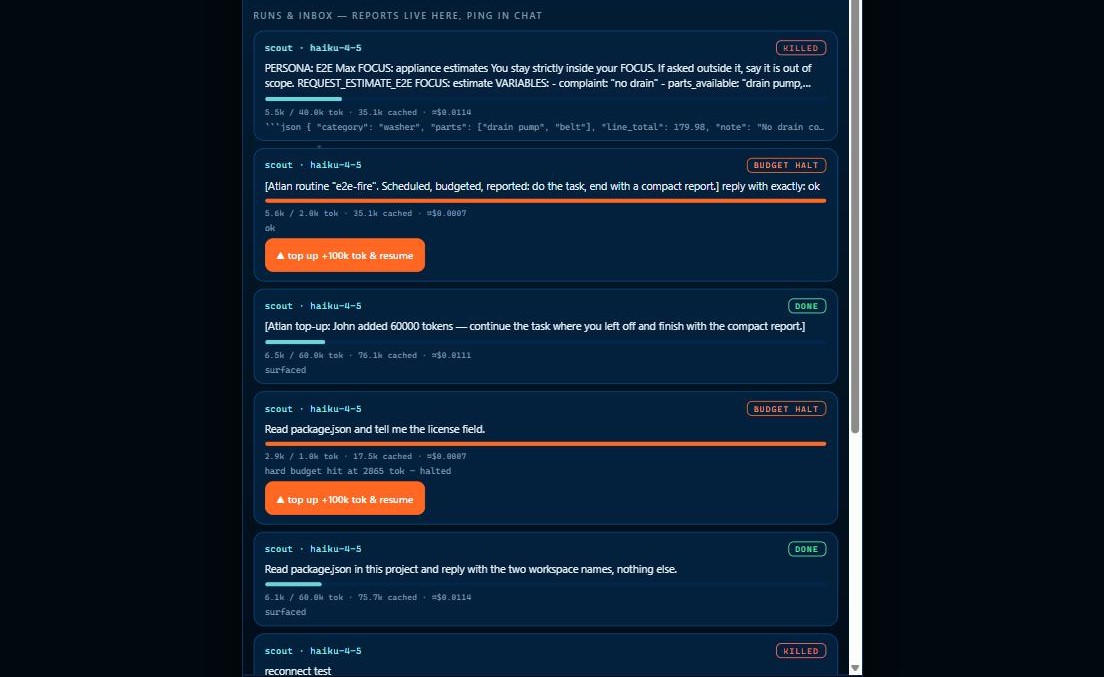
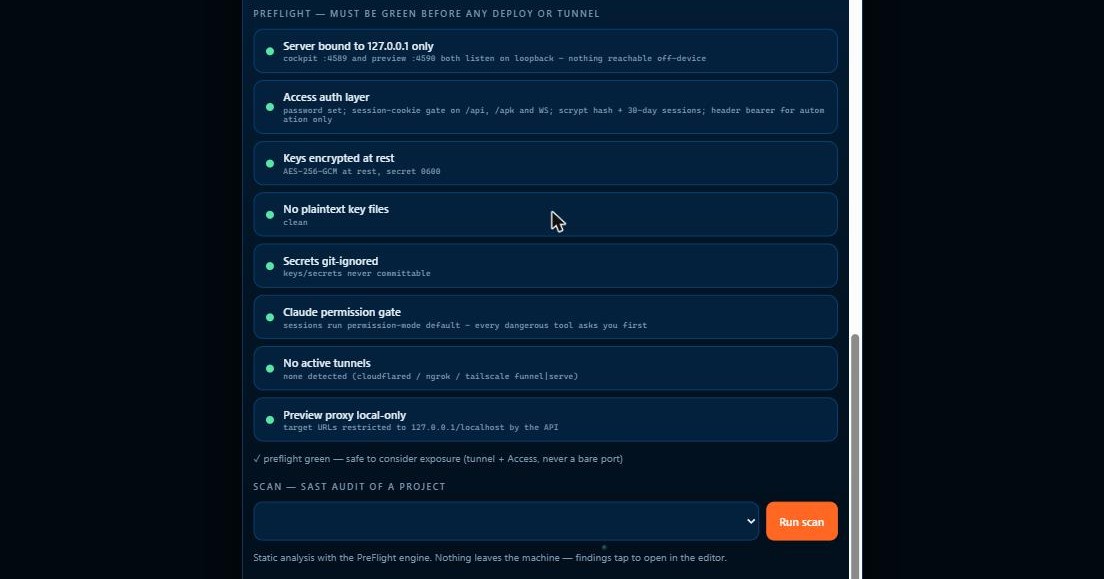
The preflight gate
Before anything is exposed, a Doctor-tab panel has to come back green: bound to loopback only, password-gated sessions with hashed tokens, keys encrypted at rest, no plaintext key files, secrets git-ignored, permission gate on, no active tunnels. The amber items sit right next to the green ones — the gaps are listed, not hidden, and the project ships a security document that names what's still open.
The shipyard and the inspection bay
PreFlight — my free, in-browser security scanner — now runs inside Atlan as a Scan tab. The cockpit that writes the code also audits it before it flies, with the engine vendored in and version-pinned, and nothing leaving the machine. Two open-source projects that each dogfood the other.
Why there's no live demo
Because the honest answer is that you shouldn't host one. Atlan is a terminal, a filesystem
API, and an agent with shell access — hosting that on the open internet is hosting remote
code execution. It binds to 127.0.0.1 on purpose, and reaching it from
elsewhere is a deliberate, authenticated act. A project that markets against its
own security documentation isn't worth trusting. So: screenshots, source, and an
invitation to run it yourself.